
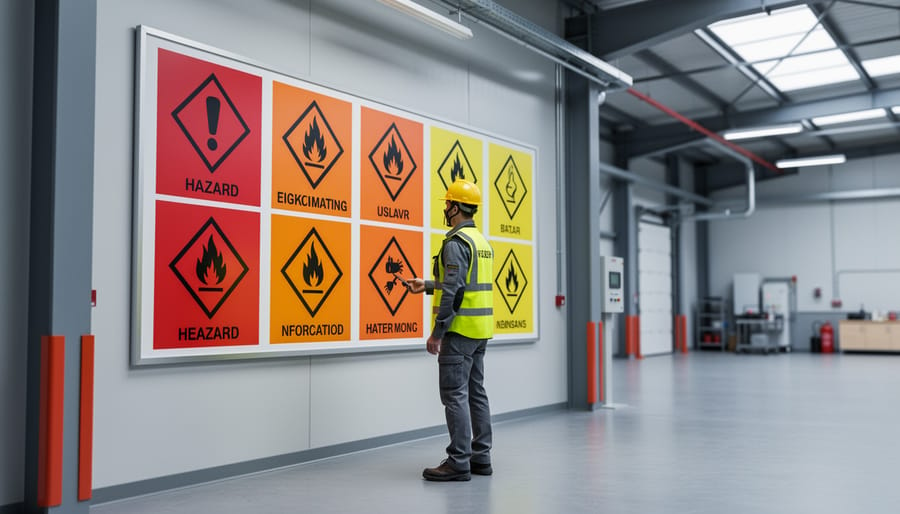
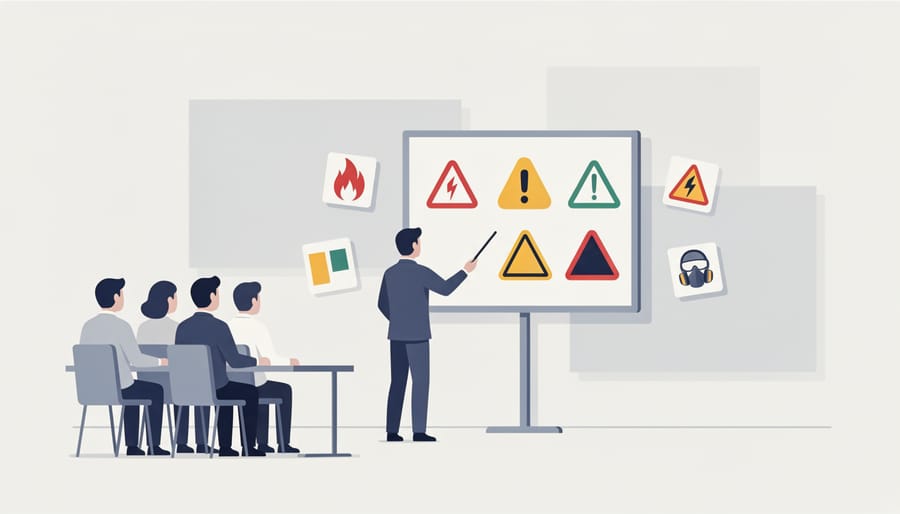
Workplace safety signs serve as your first line of defense against injuries, providing instant visual communication of hazards, required protective equipment, and emergency procedures. Under current OSHA regulations, which have adopted the ANSI Z535 standards, these signs follow a color-coded hierarchy: red signals immediate danger, orange warns of potential hazards, and yellow indicates caution. Understanding this visual language isn’t just about compliance. It’s about creating a culture where every person in your facility can identify and respond to risks without hesitation.
The renewed focus on prevention in 2026 reflects what healthcare professionals and safety coordinators have long advocated: proactive hazard communication prevents emergencies before they happen. When integrated properly with your workplace safety policy standardized signage becomes part of an environment where safety is visible, understood, and second nature.
The ANSI Z535 standards, built on the international ISO 3864 framework, provide six organized sections that guide everything from color specification to pictogram design. While these standards are voluntary and not legally enforced by ANSI itself, OSHA’s adoption of them makes compliance essential for most workplaces. This practical framework ensures that a danger sign means the same thing whether you’re in a manufacturing facility, hospital, laboratory, or warehouse.
For employers implementing safety programs, the investment in proper signage delivers measurable returns through reduced incidents and improved emergency response. For workers and visitors, these signs offer reassurance that hazards have been identified, assessed, and clearly marked. The collaboration between regulatory bodies, safety professionals, and workplace teams has created a system designed to protect everyone who walks through your doors.
Understanding Workplace Safety Sign Standards
The ANSI Z535 Framework
ANSI Z535 is divided into six complementary sections, each addressing a specific aspect of workplace safety communication. Together, these sections create a comprehensive framework that guides organizations in designing, selecting, and implementing effective safety signage.
ANSI Z535.1 establishes the color code system that forms the visual foundation for all workplace safety signs. This section specifies when to use red for danger, orange for warning, yellow for caution, and other colors for distinct safety messages. Because color recognition happens before a worker reads any text, Z535.1’s color specifications enable instant hazard identification across diverse workplaces and language backgrounds.
The remaining five sections cover safety signs for facilities and workplaces, product safety labels and tags, system safety colors and formats, accident prevention tags, and safety symbols. Each section builds on the color-coding foundation, adding specifications for signal words, pictograms, message hierarchy, and formatting requirements.
This modular structure allows organizations to apply the relevant sections to their specific needs while maintaining consistency with the broader ANSI framework. A chemical storage facility, for example, relies heavily on Z535.1 color codes and Z535.2 facility signage requirements, while manufacturers may emphasize Z535.4 for product safety labels, yet all share the same visual language, reducing confusion and supporting worker safety across industries.
Regulatory Context and OSHA Requirements
Understanding the relationship between ANSI standards and federal regulation is essential for workplace compliance. ANSI Z535 standards are voluntary guidelines published by the American National Standards Institute, not legally enforceable regulations in themselves. ANSI doesn’t have enforcement authority, so facilities aren’t legally bound to follow these standards simply because they exist.
However, in practice, compliance is effectively mandatory for most workplaces. OSHA sets and enforces standards for workplace safety, and the agency has largely adopted ANSI Z535 standards as the benchmark for safety signage. When OSHA inspectors evaluate workplace safety programs, they reference ANSI specifications for color codes, signal words, and sign design. Non-compliance can result in citations under OSHA’s general duty clause, which requires employers to provide a workplace free from recognized hazards.
This means that while ANSI Z535 remains technically voluntary, it functions as the de facto regulatory standard in workplaces under OSHA jurisdiction. Organizations that deviate from ANSI specifications risk enforcement action and, more critically, compromise the standardized hazard communication that protects employees from injuries and toxic exposures.
Types of Safety Signs and Their Color Codes
Danger Signs (Red)
Red danger signs represent the highest level of hazard severity in workplace safety communication. These signs warn of immediate threats that will cause death or serious injury without proper precautions. The red background with white lettering creates instant visual recognition, signaling workers to stop and assess the situation before proceeding.
Common applications include high-voltage electrical equipment, where contact poses fatal electrocution risk, and toxic chemical storage areas containing substances that can cause severe poisoning or death. Confined spaces requiring specialized entry procedures, such as tanks, silos, or underground vaults with oxygen-deficient atmospheres or toxic gas accumulation, also demand red danger signage. In these chemical and toxin scenarios, workplace safety teams may consult poison control centers for guidance on appropriate warning language and emergency response protocols.
The key distinction: danger signs are reserved for hazards where exposure is immediately life-threatening. If injury is possible but not certain, or if severity is lower, a different color code applies.
Warning Signs (Orange)
Orange warning signs occupy a critical middle tier in the workplace safety hierarchy, alerting personnel to hazards that could cause death or serious injury if proper precautions aren’t followed. Unlike red danger signs that signal immediate threats, warning signs indicate conditions where careful attention and specific safety measures reduce the risk to manageable levels.
You’ll encounter orange warning signs throughout facilities with moving machinery, conveyor systems, industrial presses, and automated equipment where contact could result in crushing injuries or amputations. Chemical handling zones frequently display orange warnings when substances pose significant health risks through inhalation, skin contact, or ingestion but don’t meet the threshold for immediate danger classification. These might include corrosive materials, irritants, or compounds requiring respiratory protection.
Warning signs typically appear at entry points to hazardous areas, on equipment guards, and near processes involving elevated temperatures, pressures, or toxic exposures. The orange background paired with a black safety alert symbol and clear hazard statement creates instant visual recognition, even from a distance. Employers must ensure these signs remain visible, legible, and positioned where workers naturally look before entering hazardous zones or operating equipment, placing them effectively is as important as selecting the correct severity level.
Caution, Notice, and Other Sign Categories
Not every workplace hazard poses an immediate threat to life. Yellow caution signs mark situations that could result in minor to moderate injury, think wet floors, low clearances, or areas where protective equipment is required. These signs alert workers to exercise care without implying the severity of danger or warning categories.
Blue notice signs serve a different purpose entirely. They communicate general information about workplace policies, procedures, or equipment locations rather than hazards. You’ll find them marking authorized personnel areas, visitor check-in requirements, or operational instructions. While they don’t warn of injury risk, they support orderly facility management and regulatory compliance.
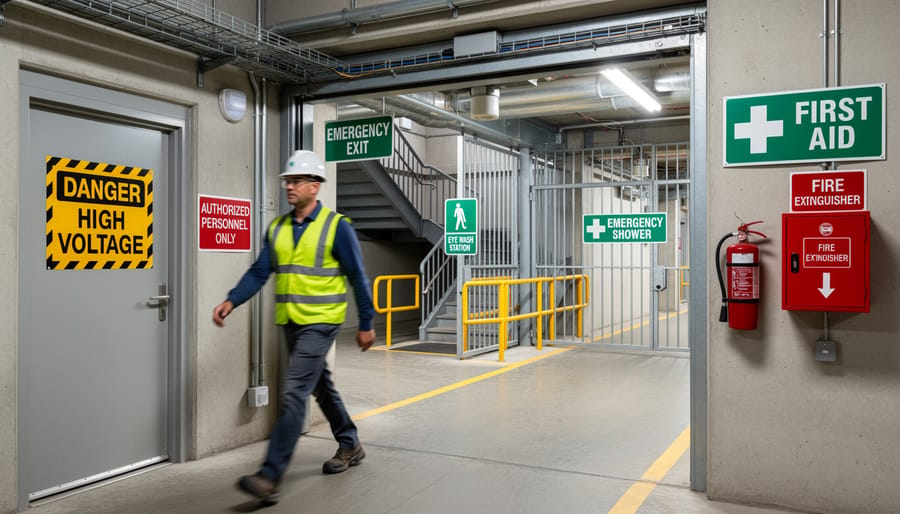
Green signs indicate safety. They mark emergency exits, first aid stations, eyewash locations, and other protective equipment. In a crisis, these signs guide workers toward help rather than away from harm. A well-placed green sign can reduce response time during chemical exposures or injuries, moments that matter when someone needs immediate medical attention or decontamination.
This hierarchy matters. When your facility uses the correct color for each message type, workers process visual cues faster. They distinguish between “stop immediately” (red), “proceed carefully” (yellow), and “safe direction” (green) without conscious thought. That instant recognition is exactly what standardized color codes were designed to achieve.
Essential Components of Effective Safety Signage
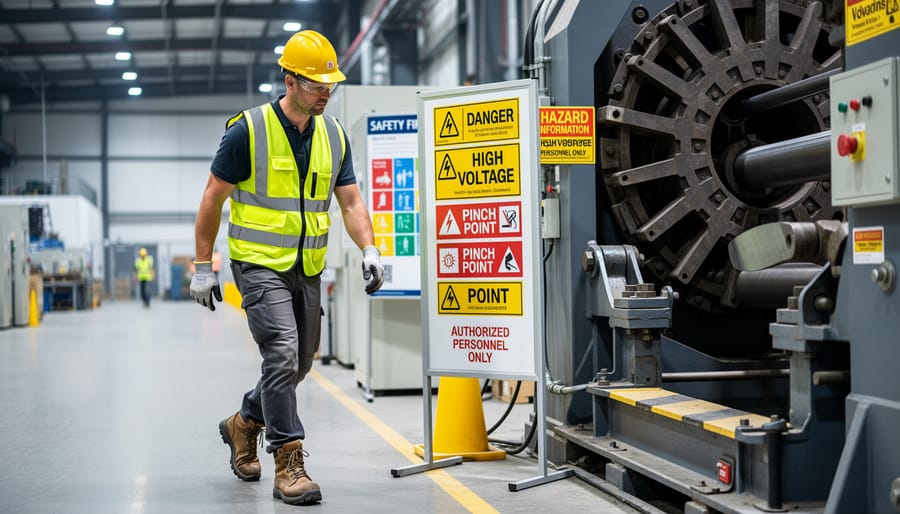
An effective workplace safety sign combines four critical elements that work in concert to communicate hazards instantly and clearly. Understanding these components helps organizations select appropriate signage and ensures employees recognize and respond to warnings correctly.
The signal word appears at the top of the sign and establishes the severity level at a glance. DANGER (in white letters on red) warns of immediate hazards that will cause death or serious injury. WARNING (in black letters on orange) indicates hazards that could result in death or serious injury. CAUTION (in black letters on yellow) signals hazards that may cause minor or moderate injury. This color-coded hierarchy, based on ANSI Z535.1 specifications, allows workers to assess risk severity before reading further details.
Pictograms serve as universal visual language that transcends literacy barriers and enables instant recognition. These standardized symbols depict the specific hazard, a skull and crossbones for toxic substances, a flame for flammable materials, or a lightning bolt for electrical dangers. In multilingual workplaces or high-stress emergency situations, pictograms communicate faster than text. They’re particularly valuable in environments where workers may be wearing protective equipment that limits their field of vision or where split-second decisions matter.
The hazard statement identifies the specific danger in clear, direct language: “High Voltage,” “Toxic Chemicals,” or “Confined Space.” This brief phrase bridges the gap between the pictogram and the detailed consequence message, naming the threat explicitly.
Consequence messaging explains what will happen if the hazard isn’t avoided and often includes the required action. “Can cause severe burns” or “May cause respiratory failure, use proper ventilation” transforms abstract warnings into concrete risks. This element is especially critical for chemical and toxin hazards, where workers need to understand both the nature of the exposure and the protective measures required.
When these four components appear together in standardized formats, they create a communication system that functions even under pressure, fatigue, or distraction, exactly when workplace safety matters most.
Safety Signs for Chemical and Toxin Hazards
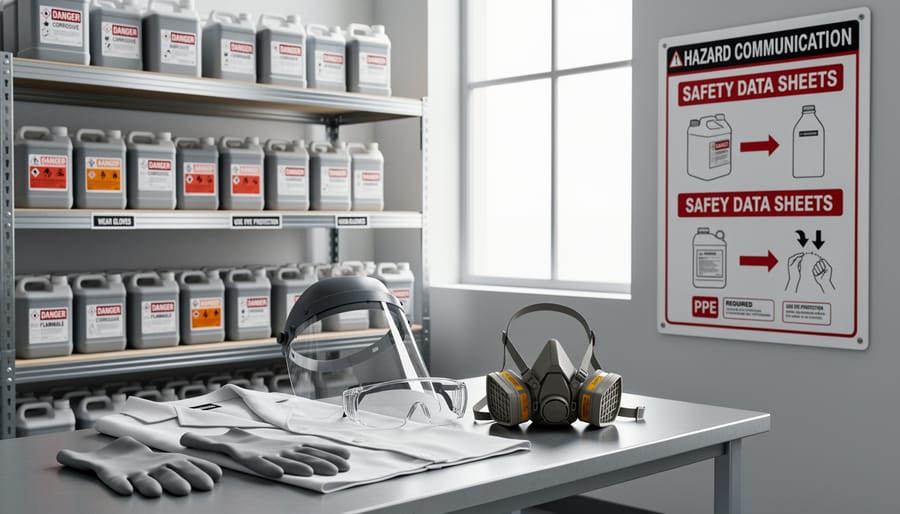
Chemical and toxin hazards demand particularly rigorous signage because exposure can cause serious injury or death within seconds. These signs go beyond general workplace warnings to communicate specific risks from substances that can poison, burn, corrode, or asphyxiate. Employers handling chemicals must combine standardized ANSI Z535 signage with substance-specific warnings that identify the exact hazard and necessary protective measures.
Red danger signs mark areas where toxic substances pose immediate life-threatening risks. A chemical storage room containing concentrated acids, pesticides, or industrial solvents requires danger signage specifying the hazard class and emergency response protocols. The sign must state not just “Danger: Toxic Materials” but also indicate whether the substance is corrosive, flammable, or poses inhalation risks. This level of detail supports first responders and healthcare providers who may need toxicological information during emergencies, the same reason preventing poisoning requires clear labeling in both workplaces and homes.
Orange warning signs appear where chemical exposure could occur during routine operations. Laboratories, manufacturing lines using adhesives or solvents, and cleaning supply areas need warnings that specify skin contact hazards, respiratory protection requirements, and ventilation needs. These signs work alongside Material Safety Data Sheets (MSDS) to create multiple layers of hazard communication, particularly important in workplaces where employees might encounter pharmaceuticals or other substances that mirror household risks associated with poisoning from meds.
Effective chemical signage includes pictograms showing the hazard type, skull and crossbones for acute toxicity, corrosion symbols for acids and bases, exclamation marks for irritants. The signal word (danger or warning) appears at the top, followed by the hazard statement and consequences. “Danger: Corrosive Chemicals. Causes Severe Skin Burns and Eye Damage” tells employees exactly what will happen and why personal protective equipment matters.
Signs must also indicate required safety equipment nearby. A sign reading “Danger: Toxic Vapors. Respirator Required Beyond This Point” connects the hazard to the specific protection needed, reducing the chance of exposure from confusion or oversight. This integration of warning and instruction makes chemical safety signage an active tool in poison prevention rather than a passive compliance measure.
Implementing a Workplace Safety Sign Program
Conducting a Hazard Assessment
A thorough hazard assessment is the foundation of any effective safety sign program. Start by systematically walking through your facility to identify hazards that require visual warnings. This process works best when you involve employees who work in each area daily, they often spot risks that others might overlook.
Follow these steps to ensure comprehensive coverage:
- Document all areas where hazardous chemicals are stored, handled, or transferred, noting specific substances and concentration levels that may require poison control consultation.
- Map zones with moving machinery, automated equipment, or vehicles, identifying points where employees might enter hazardous operational areas.
- Mark locations of emergency equipment including eyewash stations, safety showers, fire extinguishers, and first aid kits that need clear identification signage.
- Identify potential exposure points such as confined spaces, areas with temperature extremes, high-noise zones, or locations where toxic fumes could accumulate.
- Review your findings against OSHA requirements and ANSI Z535 color-code standards to determine appropriate sign types for each identified hazard.
Pay particular attention to areas where multiple hazards overlap, such as chemical storage rooms that also contain electrical panels. These locations may require several complementary signs to address each distinct risk. Document your findings with photographs and detailed notes to create a baseline for your signage plan and future safety audits.
Training and Ongoing Education
Even the most carefully placed safety signs are ineffective if employees don’t understand what they mean or how to respond. Regular training ensures workers can immediately recognize the color-coded hierarchy, red danger signs demanding immediate action versus orange warnings requiring caution, and know the appropriate response for each hazard. New employee orientation should include a comprehensive walkthrough of all facility signage, explaining not just what signs mean but why they’re positioned in specific locations and what actions to take when encountering them.
Training shouldn’t be a one-time event. Periodic refresher sessions help reinforce recognition and appropriate responses, especially when new hazards are introduced or signage is updated to meet current ANSI Z535 standards. For facilities handling chemicals or toxic substances, this education directly supports emergency safety preparedness and poison prevention efforts. CAPCC’s educational mission emphasizes that understanding hazard communication is foundational to preventing toxic exposures, whether through proper chemical handling, recognizing contamination warnings, or knowing when to contact poison control. Multilingual workplaces benefit from training that addresses language barriers, ensuring every employee can interpret critical safety information regardless of their primary language.
Common Questions About Workplace Safety Signs
Are safety signs legally required in every workplace? The answer depends on your industry and jurisdiction. While ANSI Z535 standards are voluntary guidelines published by the American National Standards Institute, OSHA has largely adopted these standards for workplace safety signage. This means that for most regulated workplaces in the United States, compliance with ANSI-based safety signs is effectively mandatory to meet OSHA requirements. Specific industries with chemical hazards, heavy machinery, or other high-risk environments face stricter enforcement.
How often should workplace safety signs be replaced?
Replace signs when they become faded, damaged, or illegible, typically every 3-5 years depending on environmental exposure. Regular inspections help ensure signs remain visible and effective.
What should we do if workers speak different languages?
Use pictograms as your primary communication tool since ANSI Z535 standards emphasize visual symbols that transcend language barriers. Consider adding multilingual text panels in areas where workers consistently speak specific languages, but remember that standardized symbols should be understood regardless of text.
When should we contact poison control after a workplace exposure?
Contact a poison hotline immediately if an employee is exposed to a toxic substance, even if signs were posted. Healthcare professionals at poison control centers can provide specific guidance on symptoms, first aid, and whether emergency medical care is needed.
How do we know if our existing signs meet current standards?
Compare your signs against ANSI Z535.1 color specifications: danger signs should be red, warning signs orange. If your facility still uses older formats that don’t follow this hierarchy, plan a phased update to bring signage into compliance with current ANSI standards adopted by OSHA.
Another common question involves maintaining sign effectiveness over time. Conduct quarterly walk-throughs to check for obstructed, damaged, or outdated signage. Environmental factors like UV exposure, moisture, and chemical vapors can degrade sign materials faster than expected. In chemical storage areas where CAPCC expertise applies, signs warning of toxic hazards require particular attention since faded or missing warnings directly increase exposure risk.
Organizations updating older facilities often ask whether they must replace all non-compliant signs immediately. A risk-based approach works best: prioritize high-hazard areas first, such as zones with red danger signs for immediate threats, then systematically address lower-severity warnings. Document your upgrade plan to demonstrate ongoing commitment to safety compliance during inspections.
Workplace safety signs work best when they’re part of a broader prevention strategy, not just regulatory checkboxes. The standardized communication provided by ANSI Z535 color codes and pictograms creates immediate recognition across diverse workforces, but signs alone can’t prevent accidents. Effective hazard communication requires consistent employee training, regular signage maintenance, and integration with comprehensive safety resources.
Organizations that treat safety signage as a collaborative effort see measurably better outcomes. This means involving safety officers, healthcare providers, and specialized resources in your planning. For workplaces handling toxic substances or chemicals, partnerships with toxicological experts like those at poison control centers strengthen your prevention framework. These collaborations ensure that when employees encounter danger or warning signs in chemical storage areas or handling zones, they know exactly what actions to take and where to find immediate support if exposure occurs.
The reassuring reality is that proper signage implementation dramatically reduces workplace injuries and toxic exposures when combined with ongoing education. Employees who understand what red danger signs versus orange warning signs mean, who’ve been trained on emergency response procedures, and who know how to access expert guidance respond more effectively to hazards. Your safety program becomes stronger when signs serve as visual reminders of training, when color codes trigger learned responses, and when your team knows that specialized support is available for poison-related emergencies or unusual exposures.
Standardized signs, informed workers, and accessible expertise create the foundation for safer workplaces in 2026 and beyond.